
Through Relationship Anarchy: From Polyamorous Triad to Consciously Celibate.
How two years of open relating started with profound expansion and led to a slow destruction

This is Part 2 of The Initiation. In Part 1, I described the night in late 2022 when I experienced an Ontological Crisis. This is the story of the next domino.
I am at a campsite somewhere in Texas, at an event for 7-, 8-, and 9-figure Entrepreneurs, immersed in a conversation with Lee Holden, a Qi Gong master. He tells me about a documentary he self funded, then sold to Gaia. I tell him about my vision for journalism and storytelling. He responds immediately, “Have you met G?”
This would be the first of many times someone asked me if I knew G. Tell me that’s one of your soul mates with past-life contracts without telling me lol.
I respond, “No, who’s G?”
He looks over to the other side of the big round table we’re sitting at. There he is, sitting directly across from us at lunch. I see G for the first time. Positioned exactly in the middle of the table he almost looks like Jesus at the Last Supper. He listens intently to the man sitting next to him. He is hyper-concentrated, focused on the conversation. He has long wavy hair, but it is tied back. He has an earthly, rugged masculinity yet a softness in his aura. Strong facial hair, not quite in a full beard. His dark hair and eyes contrast with his lighter skin. He radiates mystery.
I am almost in a trance as I stare at him, then catch myself and look back at Lee before G sees me. “G has been to over 80 countries. He’s tested over 100 different psychedelic compounds on himself. He’s nomadic like you and lived in Melbourne for years.”
“Whoa. I need to meet G,” I said, as I wondered if he saw me through the corner of his eye.
I see him later that evening at the dessert buffet. I walk up to him. My eyes are glued to his face. I am fixated on his eyes. I hold his gaze as I introduce myself, “Lee told me that I need to meet you! I’m actually originally from Melbourne. I’ve been nomadic for 4 years, and I also went to West Papua.”
We are both standing by the dessert table, completely locked in each other’s gaze, in a moment where it feels like we are the only two people standing on this earth. I am mesmerised by his presence. “If you want to know more about my life, someone wrote a book about it.” As he tells me the name of the book, I bring up my phone to Google it. “I’ll show you.” He takes my phone and types his name into Instagram, then shows me a post with the photo of the book.
Lee comes to get us: “The party’s starting!” I wanted to continue the conversation. “Shall we all walk down together?” I ask. My suggestion is met with encouragement. We all walk down to the event. G continues to regale me with various travel stories that illustrate his counterculture character. Where some women might be disgusted, for whatever reason, I was enthralled.
There is a tractor that takes us to the on-site planetarium. As we sit in the back, he places his hand on my left leg. I place my left hand on top of his, and we begin holding hands. Tension builds. I feel electricity traveling through my skin and down my spine. As the astronomer delivers a presentation on the stars, G whispers inaccuracies the lecturer is making on the cosmos, demonstrating the vastness of his knowledge. I am completely enthralled by his mind. We are seated in the back row, holding hands. Our eyes lock, then our noses graze. Our lips touch, for a brief moment. We are surrounded by people, but it’s dark; I wonder if anyone can see us. Technically, there is a policy against romance at these events, making how public and almost uncontrollable it is even more exciting. I clench, almost breathless. The session ends.
As we return, I am immediately bored by everything except the idea of his body pressed up against mine. “Do you want to walk back?” I ask. He nods, and we walk back together in the darkness. When we arrive at the parking lot, we stop, and he kisses me.
We spent a lot of the following day and night together. As he kissed me goodbye, he asked, “When will you be in LA?” “After Summit for a few weeks,” I reply. He nods as if making arrangements in his mind. “I’ll keep you posted with my movements,” he says as he walks off into the night. I laugh to myself, thinking, Who is this man? I never thought I’d see him again.
Two weeks later, he comes and stays with me in LA for what was supposed to be a few nights, but what turned into several weeks. We spent hours talking deep into the night, swapping stories, going on long walks, and made our way to an MDMA fueled party in Venice, followed by a long bath at home and a swim in the ocean the following afternoon. We opened quickly and journeyed deeply even faster.
Somewhere between his arrival and the MDMA, he said, “I’m nonmonogamous.”
My curiosity and attraction toward him far exceeded any form of protective common sense and logic in the weeks that followed. I told myself it didn’t matter because this is what life is about — surrendering to spontaneity and deep connection. I have always been rather romantic that way.
Then, three weeks later, we both needed to go “home”. He to London, and I to Bali. He picked a flight leaving on the same day as mine, slightly afterward, so we could go to the airport together. He waits with me at my gate, our bodies suspended in a locked embrace. The announcer makes the last boarding call. We stand up and hug one last time. It was the perfect month-long romance.
He kisses me, says “I love you,” then runs to his gate and waves from the distance.
What the fuck.
I spent the next 20-something hours crying my eyes out on the plane. I had just fallen in love with a non-monogamous man.
The choice
I was presented with a choice. Say “thank you, not for me” and walk away right then and there. Or embark upon a journey to discover whether, underneath societal conditioning and collective ideals, there was truth in the narrative that perhaps humans are not actually built to be monogamous.
I knew that if I decided to go on that journey, I needed to do it for me. I needed a genuinely intrinsic motivation to ensure I remained empowered and without regret. After another 10-day rendezvous across the world and several multi-hour-long conversations about Relationship Anarchy and his relational philosophies, I decided this would be a worthy quest.
I set out to question the monogamy narrative as possibly learned conditioning — to deconstruct it and discover what awaited me on the other side.
The first six months of that journey elicited expansion, illumination, and liberation. The last six brought me to my fucking knees.
Betrayal. Depletion. Exhaustion.
The argument for evolutionary non-monogamy
The way I would approach non-monogamy is the same way I approach everything in life. 110% all in. This meant consuming all the literature, muting all the divine union accounts, and following all the Poly accounts on Instagram to reprogram my mind to a new sense of normal.
The starting point: Esther Perel’s State of Affairs, Mating in Captivity and, of course, Sex at Dawn by Christopher Ryan and Cacilda Jethá, which asserts that for most of human evolutionary history, humans lived in egalitarian, sexually communal societies. Their central claim is that monogamy is not a biological imperative but rather a cultural technology, invented 10,000 years ago when agriculture made private property possible, and men needed to be certain which children were theirs to inherit it.
Basically, if your woman was going around shagging whoever she wanted, men had no way of knowing their offspring were biologically theirs.
Before that, the argument is that humans were more like our closest primate relatives, such as chimps, apes and bonobos — sharing resources, including sexual ones, across the group. The concept of the nuclear family, in this context, is not ancient wisdom designed to serve love but a form of patriarchal control to serve inheritance structures.
Romantic huh?
Esther Perel’s body of work largely explores the relational paradox of desire vs security. She identifies what she calls the modern burden on partnership: “Today, we turn to one person to provide what an entire village once did: a sense of grounding, meaning, and continuity.” She also explores the institution of marriage as “a romantic arrangement that began at the end of the 19th century…It is about 150 years old… and as I choose you now, you become responsible to alleviate my existential loneliness.”
She highlights that modern relationships experience strain because we impose all of our needs onto one romantic partner, expecting them to fulfill everything, then becoming resentful and disappointed when they don’t. This is an attitude that we have learned and developed as our society shifted away from communal village-based living and became increasingly individualised.
This viewpoint made logical sense. We are animals. Most animal species are non monogamous. Marriage was an invention to serve property. It is not possible for one person to fulfill all of your needs.
Very logical.
The goal of pursuing the embodiment of this way of relating was, of course, greater fulfillment and perhaps a more enduring, sustainable relationship structure.
Later in this essay, I will share my critique of these arguments and also draw a conclusion. But first…
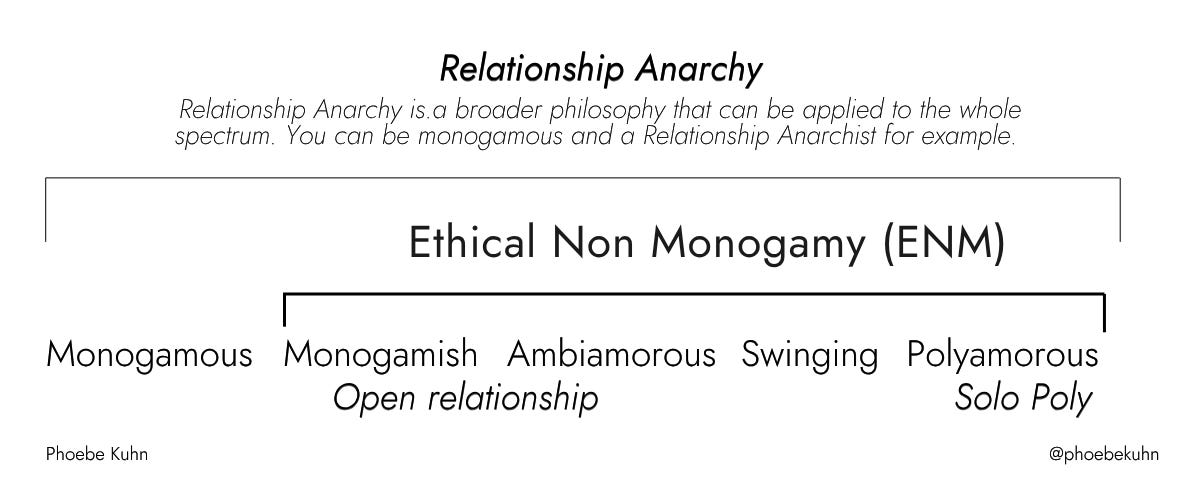
What I Gained
My inquiry into open relating gifted me with profound insight into human connection and where we impose barriers onto our experience of love.
Here are some of my biggest revelations:
The fallacy of language. In mononormative culture, we use labels to “define the relationship.” Typically, once we put a label of “boyfriend”, “lover”, “partner”, or “husband” onto something, we also project expectations of what we think that type of dynamic should look like and how that person should show up. "Well, you’re my boyfriend, so you should act this way…” or “you should do this for me.”
Have you ever caught yourself having those thoughts? Have you ever stopped to question where those expectations came from and if they are warranted?
Often, once we “define” a relationship, there is a false sense of safety or security that follows. We think the definition alleviates the anxiety from uncertainty, but this is merely an illusion. What actually creates safety and security is not a definition or a label — it’s a series of in-depth, nuanced conversations that lead to mutual agreements about what we need and desire in our relationship. That safety then gets reinforced and deepened through adherence to those agreements.
Words and labels can limit the love and connection available to us because we show up to the degree we unconsciously believe is appropriate, based on what we associate with that label. Language is then a fundamentally fallible way of defining relationships. The truest, most authentic form of a relationship is felt and known on an emotional and energetic level — rather than anything captured by a word or label.
The moment two people make something “official” and assign a word to it — boyfriend, girlfriend, partner — they can stop living in the actuality of what is genuinely present between them and start performing the label. They project a fantasy of what it means to be that thing, and begin behaving according to that fantasy rather than feeling what is real.
Labels don’t clarify love. They constrain it. And once you assign one, people stop feeling what is there and start asking how they’re supposed to behave.
Getting off the relationship escalator. In monogamy culture, there is a concept called “the relationship escalator”. This is where a relationship automatically escalates in seriousness or commitment with certain actions or events, such as meeting the parents, traveling together, or moving in together for example. The problems with this are similar to the above. There is a set of preconceived unconscious assumptions associated with these events that often prevent continued conscious negotiation and agreements. Often, women fall under the illusion of thinking a relationship is more “serious” or “committed” than it actually is because they interpret and analyse signs or indications of escalation rather than taking things at face value. This concept could have its own essay, so keep in mind I’m shortening things for the purpose of my overall piece.
Non-hierarchical relating. The conventional model of relationships is deeply hierarchical — there is a primary partner, and then there is everyone else. The Philosophy of Relationship Anarchy challenges the concept of hierarchy and asks: why should one relationship automatically be more important than another? Why should a romantic partner outrank a best friend of twenty years, a sibling, or a parent? Why should the person you sleep with have more claim on your time and loyalty than the person who has held you through every crisis of your adult life? Hierarchy is programmed into our culture and often results in a swift abandonment of relationships that are not central or primary. This can be destructive to communal and familial connections. When all relationships are central, we experience a broader, healthier interconnectedness.
It is possible to love multiple people at once. Once you’ve experienced loving and being loved by multiple people simultaneously, you realise love is not a finite resource and being in deep connection with more than one person does not diminish the love you feel for any of them. If anything, it expands our capacity. Every relationship has a different texture, and the beauty of open relating is having a varied experience of different textures, and experiencing yourself through different lenses. Certain people naturally bring out different parts of us and through being with the many we get to experience more variation of ourselves.
Truths about Love
One day, several months into relating with G, I was chatting to my friend Whitney in the sauna at Kuya when I spontaneously channeled a Map of Transcendental Love that with three layers to it.
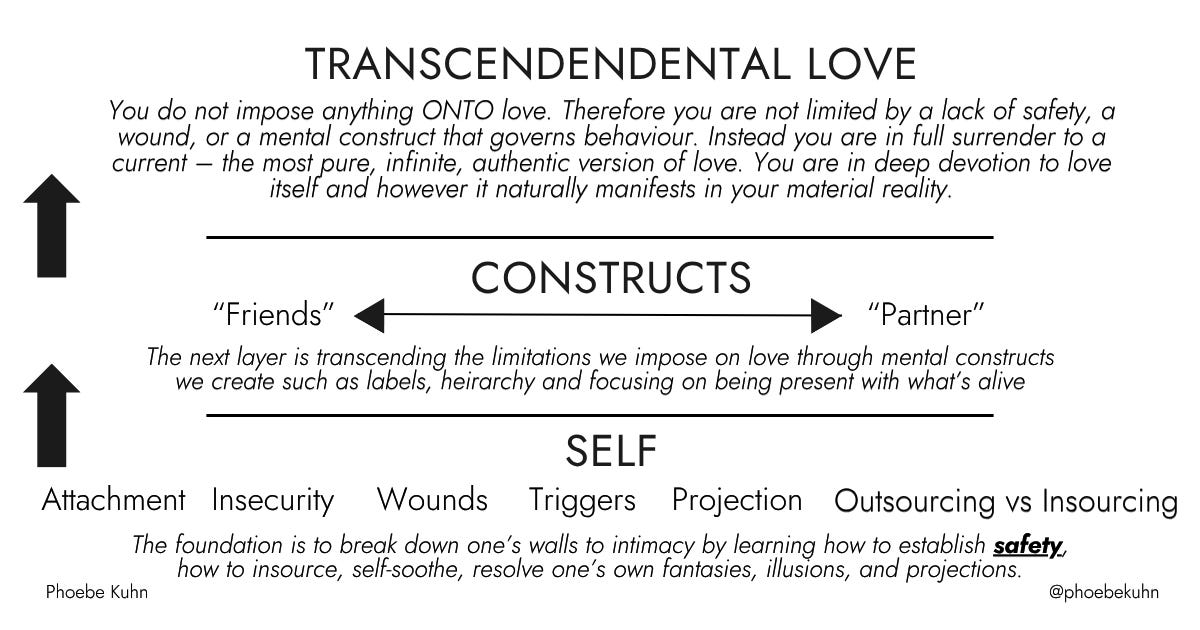
This is not limited to romantic love, but all relationships. The foundational layer is building a strong sense of safety in our relationships by learning how to insource, take full responsivility for our wounds, triggers, and bring awareness to our projections. It’s cultivating security within ourselves as a baseline. Think of level 1 as foundational safety in love as a pathway to breaking down our walls to intimacy.
Level two is breaking down all learned conditioning and constructs around love and relating. This is not limited to the examples of hierarchy or labels. The focus here is on deepening one’s awareness of texture, current and presence of energy. This is where we enrich our experience by feeling what is, rather than projecting our desire or fantasy.
This practice gives us the ability to access transcendental love — a love that is not limited.
Now, for the gnarly part…
The costs of Open Relating
After the initial dopamine and oxytocin high wore off, I experienced my first “breakup”. Three became two. Then two months later, another breakup and two became one.
A bit less than a year later, I deescalated with my last remaining partner. A few months passed, then I met a Polyamorous man, and we became involved in a more traditional Poly constellation (versus more casual long-distance ENM anarchist-style dynamics). If this makes no sense to you, I totally understand lol. Basically, I went from having non-labeled, more loose style connections to having one boyfriend in the city that I lived in, whom I saw 3-4 days a week. He’s what you’d call an “anchor partner”. In my previous dynamics two of my partners did not have other partners. Just other connections. One of them had a wife but was so madly in love with me that I lapped up all of the attention (which is why we had to breakup).
I’d never really been in a dynamic where my partner had to balance and juggle his attention between me and another partner. Suddenly I was continuously in situations where I felt I needed support, or affection and wasn’t receiving what I needed because he was tending to his other partner and the other shoe dropped.
I didn’t like this at all.
This fucking sucked.
After almost two years of good times, I knew this was the line in the sand. Polyamory ain’t for me. Then he asked me to go traveling with him in Mexico. Traveling?! I wanted to deescalate, not deepen our intimacy by traveling together. This tension of him wanting more and me wanting less increased over the next several months until it eventually broke me.
We met in Mexico, because the romantic part of me wanted to honour our connection by spending some quality time together and saying goodbye in person rather than over the phone… but because he liked it spicy, he stated he wanted to catch up with another woman whom he’d known long distance for some time while we were together in Mexico. Sure. I’d never gotten jealous before. Why now I figure.
But something was different this time. He came back from seeing this other woman. happier. He had a skip in his step, and there was something about that that cut me. I spent hours processing to arrive at compersion. Then somehow we ended up all moving in together, and forming a triad while I watched my boyfriend fall in love with another woman.
Vicky, Christina, Barcelona, eat your heart out.
Arriving at genuine love, joy, and acceptance took a lot of energy for me. Cracking through my insecurities and establishing safety kept me up until 6 a.m. one night. Relationships are a lot of work. Poly relationships are a lot of fucking work.
By the end of Mexico, I was so exhausted I was definitely done. I retreated to Bali by myself for 6 weeks to recover from burnout on all fronts. When I returned to Berlin, after two weeks, he wanted to introduce yet another woman into the constellation and I thought I was going to have a meltdown.
It was endless, and my capacity was shot.
I didn’t have the bandwidth to keep processing. Then the conversation became him constantly asking me why it required so much energy to process, rather than just not sleeping with everything that moved to give me some peace for a god damn moment.
At the beginning of my quest, I had boundless capacity for a multitude of experiences, and as time went on, this capacity eroded while I crumbled.
For me, open relating became a very simple cost/benefit analysis.
Everything comes back to our values hierarchy. If you are the type of person who highly values connection, novelty, expression, and play over everything else, then polyamory or open relating could work well for you. If you are someone who has a high value for mission/service, career, and contribution to humanity, then the amount of energy required for processing will detract from your mission and ability to create.
Another consideration is the exchange of energy within the energy body. We take on the energy of our sexual partners, and we carry this in our wombs. We store their DNA in our bodies, and we can carry this for years. If we’re exchanging sexual energy with someone who has an addiction, then that is in our body… if they have a lot of trauma, we then carry that trauma.
Energetic hygiene is something not discussed enough when it comes to sexuality. People talk about sexual hygiene and STI’s… but not the energetic hygiene of how taxing it is on the body to take on that much sexual energy from other people. You’re carrying a lot, and it does erode the system, unless you have a special ability to process that level of energy and hold it on a day-to-day basis. I do know a few people who have that ability, and I am not one of them.
Relationships & Modern Dating
The challenge most people face in modern relationships is that they are seeking fulfillment through a relationship. They project their unmet needs and longing for wholeness onto a partner, then experience disappointment.
Dating then becomes another form of escape from the deeper spiritual work of cultivating our relationship to ourselves and to life itself. Our romantic relationships can become a distraction from our own self-actualisation — a way of staying perpetually busy with someone else’s reality rather than sitting with our own.
The dopamine hit of a new match in modern dating culture has amplified this, creating a neurological loop that is functionally indistinguishable from addiction. Most of us are not looking for love. We are looking for our next hit.
Modern sex and dating are a hook in the matrix.
A way to keep us in a perpetual state of seeking, hunting, filling, and satisfying our desires. I would argue that operating in these states overrides one’s ability to exercise discipline and stoic abilities that create more long-term satisfaction with one’s life.
Think about it like this — just because you’re hungry, doesn’t mean you should be eating all the time.
The ancients understood this. Fasting was a pathway to transcendence. Sexual containment was not repression — it was the conscious redirection of life-force energy toward something greater than the next dopamine hit. Monks and sages throughout history have demonstrated that the mastery of appetite does not limit our experience. It expands it.
This is why I decided to become consciously celibate. My priority is increasing my energy reserves and redirecting it into creation and personal power. So far, so good.
It’s not Mono vs Poly — a Conclusion
For as long as I’ve been around, there’s been a debate about which form of relating is superior, authentic, or more enlightened lol.
But this debate is a false binary.
Neither mode of relating is right or wrong. Neither is better than the other. Both have costs and benefits. Both can work. The reality is that most of the population have terrible communication and relationship skills… and our society is riddled with unhealed trauma. This is what it comes down to.
Neither Polyamory nor Monogamy are supported by the current structure of our society.
Polyamory works in a world where we live in tribal based villages. This is a utopian idea where women support other women and children are raised by the entire community. In this utopia, women do not feel abandoned or alone because they are supported by the village. There is an abundance of help, love, and resources. But this is not our modern world. Maybe on the savannahs of Kenya, but certainly not in Austin, Texas.
On the other hand, we see divorce rates skyrocket because we are isolated and expect our one romantic partner to, as Esther Perel puts it, “be our everything” and be the role of the village.
Thus, the answer to infidelity or boredom is not necessarily Polyamory or ENM.
We must instead look at the fabric of our intensely isolated modern world and seek to restore the connective fabric of interconnectedness that we have lost as a species.
This is the real solution to our relational problems.
My Critique of The Anthropological Argument
Earlier, I cited literature asserting that “humans are not biologically monogamous”. Here is my critique of that hypothesis.
Modern science and anthropology have a very limited understanding of human biology and currently account for only 10% of our genome (DNA). It is widely asserted that humans are only utilising approximately ~10% of our brains, or our potential as a species.
We are capable of much higher thought. We are capable of accessing transcendental states and much higher levels of consciousness, but as a society, we are riddled with illness, hedonistic distraction, and the constant threat of survival and extinction.
We also know that Epigenetics plays a big factor in how our genes are expressed. What if humanity had an environment that facilitated our highest abilities for discipline, transcendence, and fulfillment? Union is something that is chosen every single day. Well, I believe there are certain muscles we can develop in our personal evolution that make the concept of hieros gamos far more attainable than we have been led to believe.
Our history is not an accurate indication of our biological ability. Give us the tools and support we need to cultivate monogamous relationships as a species, and see what happens.
Stay tuned for Part 3 of The Initiation: Mold, Misdiagnosis & The Illusion of Health.
You’re a ten. Don’t trade your ten for three threes.
Thank you for sharing this. I really appreciate the way you write. You really have a gift for opening up perspectives without telling people what to think. It has definitely left me reflecting on my own views and assumptions afterwards. I have really enjoyed reading your work and looking forward to reading Part 3!